TLDR
-
A Superfluid bug on Celo created invalid, unbacked G$ that entered circulation.
-
The identified excess supply has been removed from circulation. Refunds for eligible wallets will be processed on 15 October 2026.
-
Review your wallet’s burn, explanation and any refund in the burn and refund list. If the recorded result is correct, you do not need to take any action.
-
If you believe your burn or refund result is incorrect, submit supporting information through the appeal form by 13 October 2026, 23:59 UTC.
Overview
On Friday 4th of September 2026, a bug in the Superfluid protocol was detected on Celo allowed a malicious Super App to bypass the normal liquidation process for streams.
Under the normal Superfluid process, a stream stops when its funding is exhausted. Because the liquidation process was bypassed, the affected streams kept running and continued sending G$ into circulation even after they should have ended. This G$ was not backed by the GoodDollar Reserve and should never have been issued into circulation.
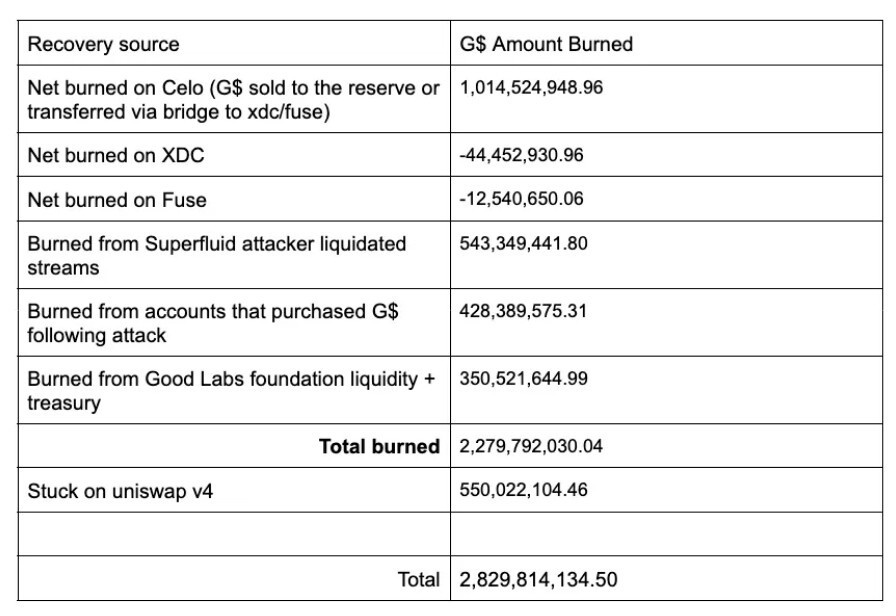
This resulted in 2,829,814,134.50 G$ of invalid excess supply entering circulation through the affected streams controlled by the attacker.
The attacker sold 1,455,810,520.61 tokens to liquidity pools plus 800,913,559.74 to the Celo Reserve and 5,426,992.40 to random wallet addresses.
Malicious Super App contract: 0x932424d333475F48ABcD9A61F570416B542bB94d
Streams on the Superfluid explorer
Attacker buyer address: 0x5eC2418E24cC9Dead4bB8e062d226Bb70a1d05c8
The excess G$ was transferred and sold through the market, including against assets in the GoodDollar Reserve and external G$ liquidity pools. Once traded or transferred, it became mixed with other G$ balances, liquidity positions, and contracts.
The recovery was designed to return the system to its pre-incident state:
-
remove the excess G$ from circulation;
-
restore Reserve values;
-
restore liquidity; and
-
normal G$ market conditions.
Recovery accounting
The recovery review accounted for G$ across Reserve activity, Superfluid contracts, liquidity pools, bridge activity and other recovery measures.
This table is a recovery reconciliation, not a list of burn transactions. It records the excess G$ identified and addressed through these recovery sources. The burn sections below list the on-chain G$ removal actions executed to date.
G$ sold against the GoodDollar Reserves was already burned through the Reserve redemption mechanism. The Reserve figures below therefore reflect the net G$ recovered through that process.
There are still 550M G$ in the Uniswap v4 pool on Celo, deposited by a trader not related to the attacker. The pool is blocked at the protocol level for G$ transfers. The owner has been contacted regarding the recovery of these funds.
Burn actions
To carry out the recovery, GoodDAO executed upgrades to the G$ token contracts on Celo and XDC under the Protocol Guardians emergency process. This process authorizes emergency protocol updates through the Protocol Guardians.
The function was added in response to this incident and used for the burn actions documented below. Each action can be verified through the transaction links in this report.
This exceptional recovery action was carried out to remove the invalid excess supply and support the restoration of Reserve and liquidity conditions.
How the burn and refund amounts were determined
The recovery review was designed to remove G$ connected to the invalid excess supply while recording refunds for eligible holders who incurred a verified net loss.
Once the excess G$ had been traded, transferred, or deposited into a contract, it could no longer be separated at the individual token level. The review therefore traced the affected flows across wallets, related wallets, staking contracts, GoodDollar pools, and liquidity positions.
As a result, some of the excess supply was subsequently acquired or received by holders who were not involved in the exploit. Inclusion in the recovery process does not imply that a holder participated in or had knowledge of the exploit. Where G$ was acquired at a price affected by the incident-related excess supply, it was included in the burn because that excess supply needed to be removed from circulation. For each reviewed holder, the following were considered:
-
net G$ purchases;
-
current G$ balances on Celo and XDC;
-
transfers to related wallets, staking contracts, and GoodDollar pools;
-
G$ sales; and
-
profit or loss from liquidity positions.
G$ was included in the burn where the review found that it remained in a wallet, related wallet, contract, or position connected to the affected flows.
The pre-incident reference price was $0.000117 per G$. All transactions during and after the incident involving G$ bought or sold below this price were reviewed.
Each buy and sale was assessed using its actual USD trade value at the time of the transaction. A wallet’s reported profit or loss was calculated as its total recorded sale proceeds minus its total recorded purchase costs.
Based on the holder-level review:
-
G$ available to burn + net loss: The relevant G$ was included in the burn. The verified loss formed the basis of the purchaser refund, plus an additional 10%.
-
Only part of the relevant G$ available to burn + net loss: The available G$ was included in the burn, and the refund was adjusted proportionally to the amount being burned, plus an additional 10%.
-
G$ available to burn + net profit: The relevant G$ was included in the burn, but no purchaser refund was recorded, as the reviewed activity had resulted in a net profit.
-
G$ transferred or deposited elsewhere: The relevant flows were traced where possible and incorporated into the holder-level assessment, including G$ held in related wallets, staking contracts, GoodDollar pools, or liquidity positions.
The complete accounting data is available in the public repository below. It includes the underlying transaction records for identified buys, sales, and other G$ outflows, allowing anyone to review the wallet activity and calculations used in the burn and refund assessment.
First Burn on September 22
On 22 September 2026, the GoodDAO, via the Protocol Guardians, executed the first set of burn actions on Celo and XDC
The first set of actions included 47 wallets whose balances were identified as containing excess G$, and 4 contracts holding excess G$.

Celo burns tx:
XDC burns tx:
-
XDC Transaction Hash: 0xd36e66d6e7... | XDCScan Block Explorer
-
XDC Transaction Hash: 0xdb8f7b33e0... | XDCScan Block Explorer
All G$ in the Celo staking contract was burned because it was held in one shared pool, so it was not possible to separate incident-related G$ from other users’ G$.
Staking holders not included in the excess-supply recovery received their corresponding G$ directly in their wallets. Two staking positions identified through the excess-supply tracing are instead included in the main burn and purchaser-refund process.
https://celoscan.io/tx/0x28c45434ac97d9b4c9ccf43e6dfac4004f67223b9a8b6023aa92a82f3aabb049
Second Burn on September 23
On 23 September 2026, the GoodDAO, through the Protocol Guardians, executed the second set of burn actions on Celo.
This second set of actions included 190 wallets that had received G$ through direct, traced transfers from attacker-controlled wallets. The hacker wallet sent G$ to random addresses.

Burn tx on Celo :
-
https://celoscan.io/tx/0xe548a248e155d94005e1701b280b5635fcc48658612b5c1d31f72976333b232c
-
https://celoscan.io/tx/0x09e60f77d9f80c5320764d623122999d70e0ff045a87dc0ecee3323c551698ed
-
https://celoscan.io/tx/0xad006543b898f6b8a408c87002cd5d241279503f54f681dffa84360f5f7c6626
-
https://celoscan.io/tx/0xe260c8678604d7355d9a2df380c62a1d023f08a5ec1c9d11fad3bc29417cd5a4
-
https://celoscan.io/tx/0x40cf6f0c03541d0043e536ee93e590ff21da77457ed08f31edadafd9c1cd705d
Third Burn on September 24
On 24 September 2026, the GoodDAO, via the Protocol Guardians, executed the set of burn actions on Celo.
This burn removed G$ from a wallet.

Burns tx on Celo:
Fourth Burn on September 25
On 28 September 2026, the GoodDAO, via the Protocol Guardians, executed the set of burn actions on Celo.
This burn removed G$ that had ended up in the GoodDollar Builders Garden community, as well as G$ held by the Good Labs Foundation as part of its liquidity position. The Foundation is absorbing the latter amount as its contribution to the liquidity recovery.

Burn tx on Celo:
- https://celoscan.io/tx/0xdf2bf7446d068285d2f99b552dfcab9c85dadb9bef4c9c5396daba7a55f83d52
- https://celoscan.io/tx/0x8947efd140f43dd20401329b871030980c17be4515060234e194e57553529bf4
Fifth Burn on September 28

On 28 September 2026, the GoodDAO, via the Protocol Guardians, executed the set of burn actions on Celo.
This burn removed an additional 5,557,524.55 G$ from a wallet included in the first burn. The wallet’s total burn amount and purchaser refund are recorded in the 22 September burn.
Burn tx on Celo:
Appeals and purchaser refunds
No action is required if the wallet treatment and recorded purchaser-refund amount are correct.
Make sure to review your wallet address, explanation and refund before starting the appeal process, if everything is correct you don’t need to submit an appeal to receive your refund.
Check the Burn and refund list
If you need to submit an appeal, please submit the wallet address, network, relevant transaction hashes and supporting information through the appel from link.
The appeal period closes on 13 October 2026, 23:59 UTC. Refunds for eligible wallets will be processed on 15 October 2026.
Next
This report covers the burn and purchaser-refund actions carried out as part of the GoodDollar recovery.
A separate GoodDollar Incident and Recovery Report will be published following Superfluid’s technical review. It will cover the incident timeline, confirmed impact on GoodDollar, mitigation and recovery actions, and the safeguards implemented in response.
Superfluid’s separate technical report will address the detailed root cause of the underlying protocol vulnerability and its remediation.
A few final steps to restore normal G$ liquidity are now underway. Another update will be shared once they are complete.
FAQ
Did GoodDollar access my wallet or other funds?
No. Like other major tokens, including USDC, G$ is governed by its own smart contract. Some token contracts include functions that can freeze, restrict or otherwise act on that specific token in limited situations. This action applied only to G$; it did not access your wallet, private key, seed phrase, personal information, or any other funds or tokens in your wallet.
Will I receive a refund?
A refund is available only where the review found an eligible net loss. A wallet being included in the burn does not automatically mean it receives a refund.
Where can I see my burn and refund result?
Check your wallet address in the burn and refund list. It shows the burn amount, explanation and any refund amount.
What if I think my result is wrong?
If the information in the list is incorrect, submit an appeal through the appeal form, with your wallet address and relevant transaction details.