GoodDAO 2.0: GoodDollar Governance Re-Vision Update

Hi GoodDollar Community,

Almost nine months since my original GoodDollar Governance Re-Vision post, I want to provide an update, along with a couple of announcements, for the purpose of eliciting further community engagement and feedback.

What we’ve done

Through the collaborative governance redesign process, “CoGov,” the community signaled the desire to reframe the GoodDAO as a system that manages money distribution to grow a collaborative economy. From this new vision, the concept of the House of Alignment emerged: a model intended to scale UBI by enabling community-driven distributions that increase G$ demand, integrations, usage, and overall network activity.

A proposal, GIP-26, was put in front of the community to initiate the first protocol distributions to the inaugural four members of the House of Alignment in an experimental pilot program designed to achieve specific objectives with regards to ecosystem growth. While GIP-26 was not approved by the community vote, the vote revealed a few things about GoodDollar governance:

  • The ecosystem has many active participants, as there were 108 unique wallets that voted.

  • Unfortunately, the same problems that other one-token-one-vote DAOs face are also present in GoodDAO, as 99% of the voting power against GIP-26 was concentrated in four wallets, and 98% of the voting power for GIP-26 was concentrated in just three wallets.

  • In addition to the governance power concentration issue, there is a breakdown in communication between GoodDAO participants, as many of the main concerns reflected in the final vote were not surfaced during the process leading up to the vote—a process that included open discussions, proposal iterations, and a community call. If GoodDAO is to be successful there needs to be more effective deliberation channels in order to better reflect community preferences beyond voting.

Despite the outcome of the GIP-26 community vote, the Good Labs Foundation has decided to fund the House of Alignment pilot in order to test the model in practice. This should be understood as a Foundation-funded experiment, not as the implementation of the protocol distribution changes proposed in GIP-26. Distributions to the member projects—Gardens, Green Goods, ReFi DAO, and Textile—will start soon. Over the next quarter, we’ll be able to collect measurable data on the program’s performance in order to use those learnings to bring a refined second iteration back to a community vote at the end of September.

Where we’re going

But the House of Alignment is only one part of the roadmap for the wider GoodDollar Governance Re-Vision and GoodDAO 2.0, as presented during the final CoGov community call. As part of this re-vision, I also want to continue evolving the GoodDAO in order to address the challenges currently facing it. This includes effectively executing on GoodDollar’s vision—building a more sustainable economy on top of GoodDollar infrastructure by driving demand for G$—and fulfilling some of the ideas and input surfaced during CoGov, such as exploring alternatives to universal token voting and implementing governance mechanisms that promote greater inclusivity.

Towards this end, I would like to the reiterate how I broadly view the GoodDAO 2.0 desired end state:

  • A decentralized governance body working towards the goal of growing a sustainable economic system around GoodDollar

  • Expert committees making operational decisions, while remaining accountable to the wider community

  • Community control over House of Alignment distributions and committee selections

The evolving GoodDAO 2.0 roadmap reflects the co-designed mission and vision of GoodDAO, as communicated during CoGov: a distributed community of participants who want to collectively contribute to and benefit from the growth of the GoodDollar economy. Throughout this co-design process, we will continue to build together towards a fully decentralized, fully inclusive governance system.

Where we are & next steps

In the context of the slides I presented during that final CoGov community call, we are in the intermediate phase of the Governance Transition Roadmap:
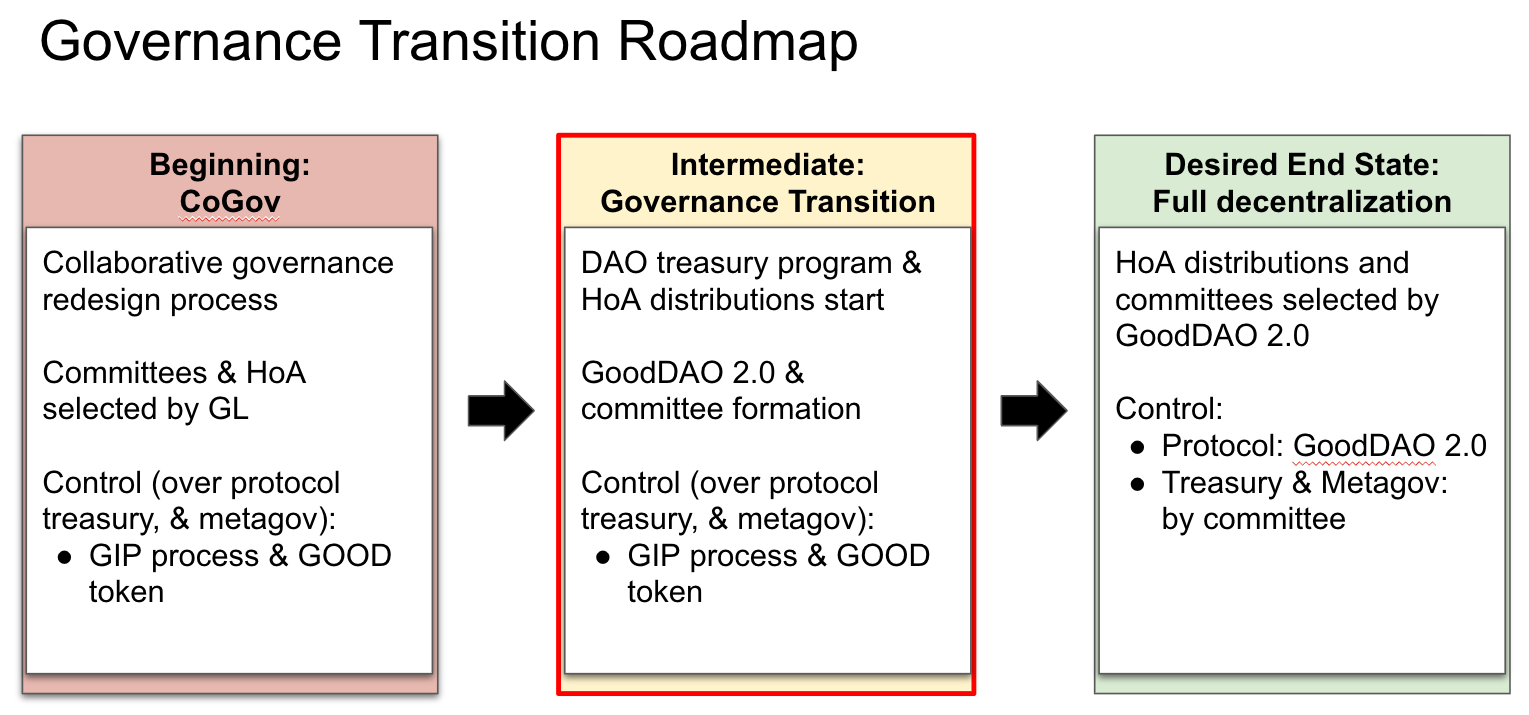
What this means:

  • As mentioned, Good Labs is ready to begin the distributions to the members of the House of Alignment.

  • I’m continuing to evolve the GoodDAO 2.0 roadmap. In addition to the House of Alignment, the next steps of the roadmap currently feature a Treasury Committee and the House of Citizenship (explained below), both of which will be opened to another round of feedback prior to implementation.

  • The GIP process and GOOD token still control all core DAO functions, including approving protocol changes, treasury spend, and metagovernance processes.

Treasury Management Committee

One of the key features of GoodDAO 2.0 will be decentralizing the management of the DAO’s community-run treasury with the objective of growing the GoodDollar economy. However, effectively managing a treasury includes business planning, asset and risk management, and financial reporting—all of which requires a high level of expertise and continuity. For this reason, I’m planning to form a Treasury Committee as one proposed mechanism to address this challenge. The committee’s members will be responsible for overseeing the sustainable allocation of DAO treasury funds in a way that supports the GoodDAO mission, while being subject to an explicit mandate, performance guidelines, and strict community accountability measures that include member selection by community vote. The structuring of this committee will also lay the groundwork for other committees or types of governance bodies that may emerge to address specific challenges over time, depending on the needs of the DAO and the feedback gathered from the community.

House of Citizenship

New structures, such as the House of Alignment and Treasury Management Committee, create new governance surface areas—new opportunities to participate and have your voice heard. Inspired by the key takeaways and insights from the CoGov process, and in an effort to make sure these new governable spaces remain inclusive, I have been designing a complementary experimental governance model: the House of Citizenship. To start, we are looking for feedback on the following key features of the House of Citizenship:

  • Open participation: Anyone with a verified GoodDollar wallet can participate

  • Democratic governance: All votes will be facilitated through a one-person-one-vote mechanism (as opposed to one-token-one-vote)

  • Limited scope: At first, the House of Citizenship will only control the quarterly distributions to the House of Alignment and the periodic selection of committee members

  • Streamlined participation: Communications and participation opportunities will be facilitated through a new central governance platform.

Before these plans are finalized and any implementation begins, I’m looking for community feedback to help continue co-designing this rollout.

As next steps, I will be hosting a community call on July 1 to discuss the following and help define what should become a formal proposal:

  • House of Alignment launch

    • Starting question: What mechanism should we use to distribute these funds?
  • GoodDAO 2.0 roadmap, including the formation of the House of Citizenship and Treasury Management Committee

    • Starting question: What would a GoodDollar Treasury Committee be responsible for? How should we hold the members accountable to the community?

Feel free to start the discussion by answering these questions or otherwise commenting on this post, and feel free to RSVP for the community call here: https://luma.com/rmydpm1w

I look forward to seeing you all there!

4 Likes

Thank you for the update and for opening this space for co-design, Sam.

​Due to prior commitments, I will not be able to participate directly in the July 1st call; however, I want to clearly and constructively lay out my stance in this thread so that it may be considered by the team when defining the distribution mechanisms for these funds:

  1. Expectation and Support for Distributions within the Gardens: It is a wise decision for the Good Labs Foundation to directly finance the deployment and allocations toward the Gardens this quarter. I am closely following the launch of these distributions and the technical criteria for participation. If the final design of the smart contracts fairly, proportionally, and transparently recognizes the weight of historical governance, you can certainly count on the support and positive vote of the community to consolidate the success and stability of this pilot for the upcoming phases. Those of us who have backed the quorum over the long term are the most invested in ensuring this new economic engine runs perfectly.

  2. The Vulnerability of the ‘1 Person, 1 Vote’ Model: Regarding alternatives like the ‘Citizenship Chamber,’ I strongly suggest analyzing the impact of breaking the token’s proportionality principle with extreme caution. A system based purely on ‘one vote per person’ can paradoxically turn into a delicate security vulnerability for the ecosystem. In developing regions—as already observed in certain dynamics in Africa and within our own region—it is highly feasible and swift to coordinate networks of 300 to 1,000 individuals to influence voting outcomes. We must be realistic: what is currently presented as an inclusive solution can transform into a manipulation and collusion issue from the very first day it is implemented. In fact, during the past vote, external coordination movements were already detected through channels like Telegram to influence results by leveraging a high volume of accounts with minimal balances. We trust that no one directly or indirectly linked to the Foundation was behind those dynamics, which alter the ecosystem’s transparency. There are governance structures and balances that are best kept stable to avoid unnecessary distortions; if the rules of the game change toward a system of coordinated identities, the environment itself will be forced to adapt and respond under those very same mechanics, which are already perfectly identified on the ground. Handing distribution decisions over to a model so exposed to cross-incentives will completely erode trust among the users who truly provide backing and stability to the protocol.

​I remain attentive to the development of the proposal in this space and hope that the defined roadmap protects the ecosystem from governance failures, building upon a foundation of mutual respect.

4 Likes

Fellow members of the GoodDollar community,

I want to express my deep dissatisfaction with the direction the governance proposal is taking, specifically regarding the introduction of the “one person, one vote” mechanism through the so-called House of Citizenship.

From the very beginning of the GoodDollar project, the “one token, one vote” model was clearly established as a fundamental pillar of our governance. The official documentation has always been explicit about this: 1 GOOD = 1 vote. This was the commitment upon which the community was built and, more importantly, the promise that attracted the investors who have believed in the project.

Many of us invested time, resources, and capital in GoodDollar trusting that our voting power in the DAO would be proportional to our stake. That was the incentive that motivated us to contribute and promote the growth of the ecosystem. The “one token, one vote” system is not a whim; it is a principle of incentive alignment that rewards those who have invested the most in the project.

The argument presented in the proposal to justify this change is based on the concentration of power evidenced in the GIP-26 vote. However, I find this reasoning flawed. Vote concentration is an inherent characteristic, not a flaw, of a token-based governance system. If four wallets hold 99% of the “no” votes, that simply reflects that those members have a significant stake in the project and, therefore, a legitimate interest in its direction.

Furthermore, GoodDollar’s own whitepaper states that the goal of the non-transferable GOOD token is “to prevent the wealthiest members of the community from gaining the most power.” This design already incorporated a safeguard against pure plutocracy by making the token non-market value and ensuring its continuous distribution. If this mechanism has not been sufficient, the solution should be to refine it, not abandon the fundamental principle that attracted investors.

Changing the rules of the game now, after many of us invested under the understanding that 1 GOOD = 1 vote, is a violation of the trust placed in the project. We were told our vote would carry weight; now we’re being told that weight will be diluted in a system where everyone, regardless of their contribution, will have the same power.

I understand that the proposal initially limits the scope of the House of Citizenship to quarterly distributions and committee selection, and that the GIP system and the GOOD token will continue to control the DAO’s core functions. However, this sets a dangerous precedent. Today it’s a limited area; tomorrow it could be the entire governance structure. The slippery slope is real.

I urge the community and the foundation to reconsider this path. If the problem is participation, let’s explore solutions that incentivize greater involvement without dispossessing those already engaged. If the problem is concentration, let’s look at mechanisms like quadratic voting that mitigate the power of large holders without completely eliminating it.

But we cannot, under any circumstances, betray the initial agreement that brought us here. The “one token, one vote” model was the foundation upon which investor confidence was built. Altering it now, even partially, erodes that confidence irreversibly.

I hope this message serves to open a sincere debate about the future of our governance, one that respects the commitments made and values ​​the trust of those who have made this project possible.

The “one person, one vote” model, while sounding idealistic on paper, ignores the real risks of manipulation and large-scale Sybil attacks in the real world of Web3.

​If we look at advanced global projects that require biometric scanning (such as Worldcoin), reality demonstrates that parallel markets exist where thousands of third-party accounts are managed. If that happens with such complex systems, implementing a 1-1 model based on early-stage digital identities within the GoodDAO would open a dangerous door in a matter of months. The risk of the protocol losing its direction due to low-cost mass manipulation of votes is both real and direct.

​As a case in point, during the recent discussion surrounding GIP-26, certain dynamics became evident in channels like Telegram where votes in favor were being requested informally, seeking to artificially inflate the number of participants (prioritizing quantity over conviction).

​If it is possible to mobilize dozens of votes at an organic level through simple proximity, imagine the latent risk if malicious actors were to coordinate local groups or direct financial incentives to alter governance. In my particular case, through legitimate invitation programs since the inception of the project, I have built a direct community network of more than 250 people within my social and family circle. If a single actor has the capacity to coordinate that volume of votes with a single message, the 1-1 model would transform the DAO into a scenario highly vulnerable to clientelism and manipulation by whoever has the greatest capacity for mass mobilization, ultimately destroying the essence and control of the protocol.

​Furthermore, we must understand decentralization as an organic and evolutionary process. Initially, the whales making decisions in the DAO belonged 100% to the Foundation; in fact, we still see wallets linked to the team, such as the one managed by Meri, actively participating in votes. However, as the project advances, power has naturally distributed itself, and today that centralized wallet no longer decides on its own. With the passing of months and the maturation of the ecosystem, those of us who currently hold a significant weight will also see our power naturally diluted by the arrival of new investors and participants who bring more capital and value. That is the true evolution of a DAO: a mature economic transition, where the growth of the project brings the necessary changes to improve and serve the community, without the need to force artificial mechanisms.

​Privately funded pilots by Good Labs are valuable for experimenting in controlled environments, and it is a positive outcome that GIP-26 was not approved, as it grants us this space for reflection. However, I invite the Foundation and those designing the roadmap on paper to carefully visualize these real-world implications before committing development resources to structures that compromise the legal certainty of investors.

​As the popular saying goes: if it isn’t broken, don’t fix it (lo que está quieto, se deja quieto). Let us perfect the existing incentives and protect the rules that attracted capital in the first place before risking the stability of the ecosystem.

In my humble opinion, given that other mechanisms based on the “one token, one vote” principle already exist, it would be interesting to implement a new one based on “one person, one vote.” However, the issue of thousands of wallets managed by a single person or group would need to be addressed (I believe it is possible to identify them; I have observed that at least one organizer of such a group asks questions in Telegram groups, and the wallets they control follow specific IP address and timing patterns—in my humble opinion, any identified wallets should be blocked from both governance and GoodDollar participation).

On the other hand, there are two main reasons why I do not feel motivated to participate in GoodDAO or future GoodDollar initiatives, as I privately expressed to GoodBuilders over a month ago:

  • Hadar Rottemberg, the CEO of GoodDollar, has publicly (for example, at Telegram: View @ReFiDAOTG ) and privately stated his Zionist views. I recall that during a GoodDAO meeting, he even praised the kibbutz model. This leads me to believe he might want to use GoodDollar to promote the Zionist agenda, which dehumanizes the Palestinian people, Lebanon, and the Middle East (including my fellow Christians in Palestine, Lebanon, and the Middle East).
  • I submitted the project https://sivel.xyz to the third round of GoodBuilders. This project helps document human rights violations and breaches of International Humanitarian Law (IHL) in Colombia, with plans to extend the work to the conflict between Palestine and Israel. The project was rejected for that round. Previously, I held a private meeting with Hadar in which he outlined a view of IHL that favors the military over the civilian population, justifies any violation by citing proportionality in achieving military objectives—without offering concrete criteria to measure such proportionality—and attempts to conceal potential cases of IHL violations. This stands in stark contrast to the approach taken by sivel.xyz, where we apply an interpretation of IHL focused on alleviating civilian suffering and present cases in the most comprehensive and accessible manner possible (following the methodology of the Noche y Niebla project which has been documenting the conflict in Colombia for nearly 30 years).

Or could GoodDAO perhaps transcend any potential Zionist agenda of the CEO and accept and promote projects that respect the equality of all human beings (not necessarily my own, though hopefully better ones)?

Desviarse hacia juicios de valor o proponer bloqueos de billeteras por supuestos patrones de red demuestra un profundo desconocimiento de cómo funciona el ecosistema en regiones como Sudamérica, África o Asia.

Hay muchas variables reales que explican la coordinación. Primero, cualquier líder de opinión o empresario puede orientar legalmente a su grupo familiar y social para votar en bloque; eso puede mover cientos de votos legítimos con IPs y dispositivos totalmente distintos. Segundo, en nuestros mercados es común el fenómeno de verificaciones pagadas. La solución para blindar el protocolo nunca será la censura o el bloqueo, sino generar una usabilidad real que haga costoso e ineficiente el acceso a esas billeteras. Lo que pasó en la votación anterior deja la seria duda de si se trató de un intento, tal vez externo, de inflar números para demostrar una inclinación de la comunidad y poder justificar un cambio, pero no les salió.

La gobernanza seria se rige por números y reglas claras. El camino de los nuevos incentivos es el correcto para estabilizar el sistema. Sin embargo, para que este proyecto piloto tenga éxito y reactive el ecosistema, los recursos asignados deben tener un impacto real y significativo. No se trata de comprometer la viabilidad del fondo con asignaciones desproporcionadas, pero tampoco de desincentivar la participación con cifras simbólicas o marginales. Si los parámetros de distribución vienen limitados, se anula el incentivo para todas las posiciones activas que dan estabilidad al protocolo. Esperamos que las cifras definitivas reflejen el tamaño de la oportunidad.

Deseo una excelente semana a todos. Tenemos toda la voluntad de seguir avanzando con paso firme y nos vemos en la otra fase del proyecto. Muchas gracias.

1 Like

Please refrain from sharing slander as that does not create a healthy base to debate things on.

More so, it all seems very offtopic to the discussion at hand. Builders program and GoodDAO have no relation to each-other.

Happy to share with you the reasons for rejection based on decisions that were made as a team and not based on a single persons personal stance and/or belief. But that conversation should happen in the designated Goodbuilders channel, or at least a different topic on discourse.

The current discussion is around the proposed new vision for the GoodDAO governance system and structure, and including associated new proposed voting mechanisms. please keep it on-topic.

I agree with the “one person, one vote” principle; however, to mitigate the risk of multiple wallets being managed by a single individual or entity, each eligible voter should possess a minimum of 10,000 G$.

Furthermore, it is crucial to recognize that individuals originating from an identical IP address should not be automatically precluded from protocol access, as they may represent members of a single household utilizing a shared Wi-Fi router.

The discussion in this thread reflects exactly the kind of substantive deliberation GoodDAO needs. These are not easy questions and the range of perspectives shared here is valuable input for shaping what comes next.

Today’s community call is an opportunity to continue this conversation in real time, before any proposals are finalized.

Governance Community Call — July 1 · 3 PM UTC
Register: https://luma.com/rmydpm1w

Looking forward to seeing you there.

Joined the call and i must say it was so great. Love the proposed idea that anyone with a verified GoodDollar wallet can participate in voting and the 1 person 1 vote idea.. feels good to be part of this project.

Thank you all who attended the call today! For those who couldn’t make it, you can view the recording here: https://www.youtube.com/watch?v=rG6BCAAbHq4

Also, here are the slides I presented during the call: Community Call (7/1) - Google Slides

As for next steps, I am going to work towards a formal proposal for the next steps in the GoodDAO 2.0 roadmap, and I will continue to welcome feedback from the community throughout the process.

1 Like

feels great having you around

That solution you’re proposing isn’t effective; any whale can buy wallets and load them with that amount of G$.

While the votes were in the foundation’s favor, GoodDAO was fine. But when the community voted differently, suddenly the voting method had to be changed. Supposedly, you want to eliminate centralization, but meanwhile, foundation members’ wallets (Meri Fernandez’s wallet 0x6823A04a6Fd4148167567D5Ef6DccA1f34Db0494 has 10.7M GOOD) hold a lot of GOOD tokens and participate in the voting.
If you strip the GOOD tokens of their power, you are virtually removing one of the biggest draws for investors. Furthermore, the GOOD token contract can be audited and monitored, but the wallet whitelisting system cannot. The “one person, one vote” system is more prone to fraud than “one token, one vote.”

1 Like

​I propose that we approve the new DAO 2.0 roadmap, the one-person, one-vote model, and the development of the Houses of Alignment, but under the strict condition of formally adding into the proposal’s text the following non-negotiable accountability clause:

​**“If the one-vote-per-person system is compromised, manipulated, or controlled by internal or external networks, or if the Houses of Alignment fail in their execution, transparency, or fund management, the Foundation directors and leaders responsible for this design shall resign from their positions immediately.”**

​If the architects of this plan fully trust the security of their model, they should be willing to back it up by putting their own positions on the line. Whoever leads the strategy and demands control must pay with their institutional head if the system sinks.

1 Like

Furthermore, if this condition is accepted, we request that the names of the specific individuals who will be held accountable be clearly listed in the proposal. The community deserves to know exactly who is behind the implementation of this model and who will be expected to step aside should the system fail. Transparency must work both ways.

The majority of the community has consistently pointed out that the “one person, one vote” model has structural flaws that expose the protocol to governance capture. Despite this, the Foundation continually insists on pushing it forward. Such stubborn insistence especially right after a major democratic vote did not go the way you wanted makes it appear that there is a vested, hidden interest at play, rather than a genuine interest in protecting the community.

Changing the fundamental rules of governance simply because current token holders exercised their right to vote looks like a convenient accommodation, not decentralization. If the architects of this roadmap are deeply committed to and confident in the absolute security of this new design, they should readily and comfortably accept this accountability clause. Security must be backed by genuine professional accountability.

Ultimately, we hope leadership does not hide behind diplomatic jargon, corporate contract excuses, or abstract technical definitions of what a DAO is supposed to be. This is a simple matter of professional accountability: if they are confident their plan works, they should stake their position on it. If not, the community cannot trust it.

@Eddie
The governance change was suggested through the co-gov process not because the vote didnt pass.
What is the hidden interest for us where we already hold a lot of voting power?
We are actually giving away this power.
All voting systems have flows, the goal is to have checks and balances.

The goal is to move more towards community committees rather than the foundation leading.

1 Like

Thank you for the clarification. However, claiming that the Foundation is ‘ceding power’ misses the core economic reality of the protocol.

Ceding voting power within a system where the token remains strictly non-transferable and holds no market value does not empower the community. It simply reveals that the true objective here is not financial value, but absolute political control. When an asset is kept artificially frozen in a closed loop, the only thing left to fight over is governance power. This heavily implies that a specific, centralized faction wants to maintain control over voting and decision-making by deploying the Houses of Alignment as a captured voting base.

If the objective is truly to establish checks and balances and hand leadership over to community committees, then the asset itself must be liberated. A community cannot hold real authority if it is legally and technically prohibited from moving its capital. If you are genuinely ready to trust the community, include a clear, phased timeline to unlock token transferability in this roadmap. Let the community actually own the value they build.

If the Foundation refuses to unlock the token and insists on pushing this model forward under the banner of ‘altruism,’ then you must back that confidence with real professional responsibility. If this new system is compromised, manipulated, or controlled by internal or external networks, or if the voting outcomes are captured, the directors and leaders responsible for this design must commit to resigning from their positions immediately.

If your intentions are pure and you are certain your plan works, you should easily accept both conditions: unlock the asset or take full responsibility if the system is manipulated. Otherwise, the community cannot trust this roadmap

Yes, the governance change was proposed through the co-governance process, and this process arose because the last moderator votes apparently weren’t entirely well-received; there were complaints from the losing teams.
You have significant voting power, but clearly not enough.
If you want to relinquish your voting power, you should stop using foundation wallets to vote—it’s that simple.
What kind of “controls” do you want to establish? Do you want the people who invested the most money in GoodDollar, buying G$ tokens and staking them instead of selling them, to no longer have the right to decide the project’s direction? I will never agree with that.

“The goal is to move towards community committees instead of the foundation leading the process.”
Community committees managed by the foundation? No, thank you. Leave everything as it is; stop trying to manipulate everything. It’s too obvious.

1 Like